
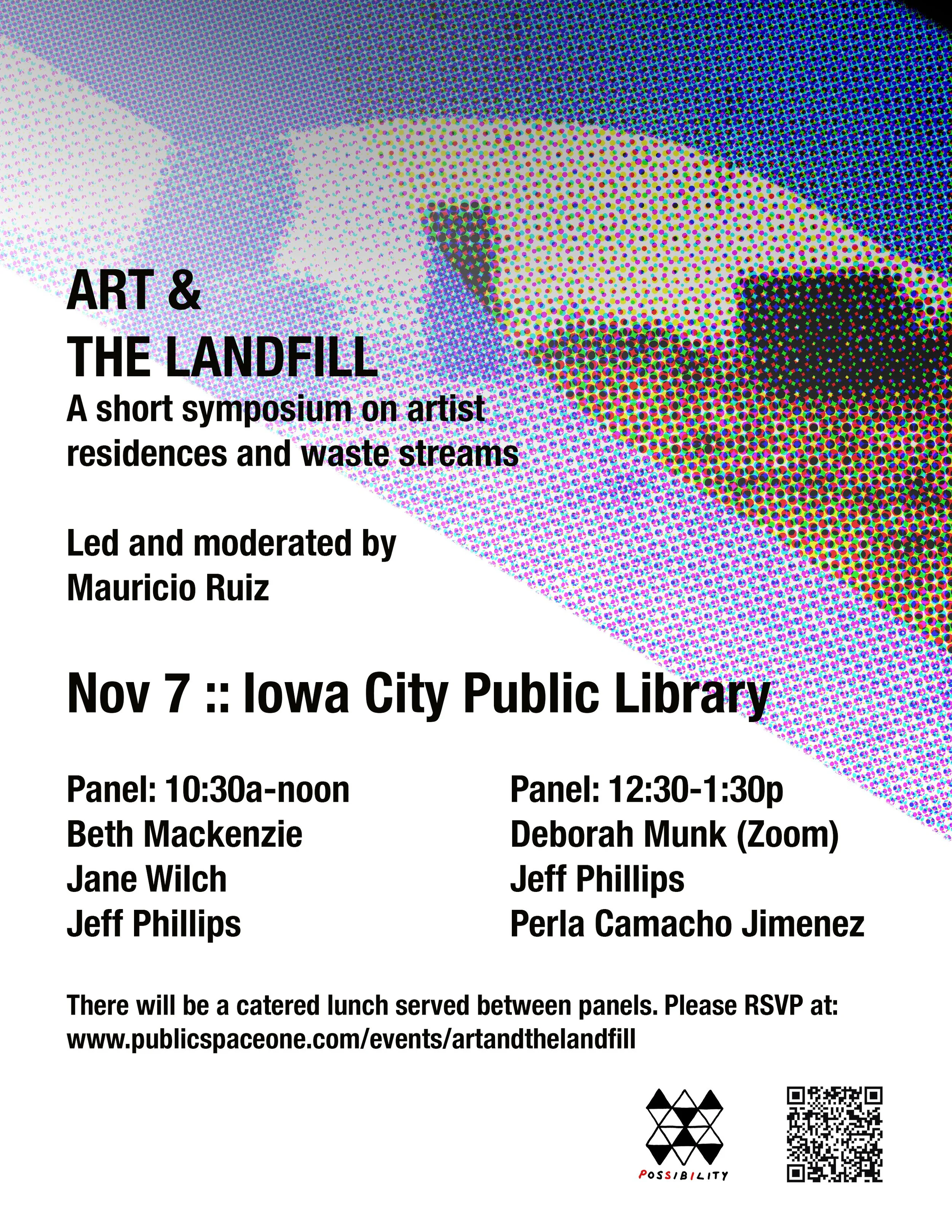
Art and The Landfill
A short symposium with two panel discussions on consumption habits and art residencies moderated by Mauricio Ruiz.
Schedule:
10:30a-12:00p :: Panel 1: Waste management, consumerism and our impact on the environment w/ Beth MacKenzie (UI Office of Sustainability Program Manager), Jane Wilch (Recycling Coordinator, City of Iowa City), and Jeff Phillips (SCS engineers & Vice Chair of the West Des Moines Public Arts Advisory Commission)
Scientists have found micro and nanoplastics in human blood, lungs, brain tissue, among others. There is not one but five giant garbage patches occupying 40% of the oceans. Trash has been at the top of America's exports for several decades. What is the impact of consumerism on the environment? If everyone else is doing it, does it matter if I make a different choice? What is Extended Producers Responsibility and why it could change how we make those choices? Is plastic really recyclable?
A panel discussion with experts in environmental science and waste management in Iowa.
12:00-12:30p :: catered lunch
12:30-1:30p :: Panel 2: How can art help reshape our relationship to nature, the environment, and the impact of our choices? w/ Perla Camacho Jimenez (UI MFA Candidate in Ceramics), Deborah Munk (Recology AIR Program Manager), & Jeff Phillips (SCS engineers & Vice Chair of the West Des Moines Public Arts Advisory Commission)
Art, like science, is a system of inquiry. Whether an artist chooses to research emotional, existential tensions, take on reparative work within their community, apply pressure to and subvert dynamics of social inequity, they are engaging applied and theoretical methods of learning that call for curiosity, connectivity and a deep questioning of the status quo.
How can art thinking shape and support conscientious innovation around material use and material value?
In addition to art existing as a professional research field, it is also one of the most ubiquitous cultural currents that touches human beings' daily lives. The urge to create, and to connect through stories, images and song, is undeniably a part of human flourishing and meaningful relationship with human and non-human ecologies. How could acknowledging the value of art be a powerful part of solving our current crisis of overconsumption?